Your first job is to understand the situation, not to book anything. Ask for the doctor in charge of the patient's care. If language is a barrier, ask whether the hospital has an international patient desk.
Write the answers down with the date and time. The insurer and any medical transport team will ask you the same questions.
The doctor's name and a direct phone number
The diagnosis, in plain words
Whether the patient is stable right now
What treatment is planned over the next 48 hours
Whether this hospital can provide that treatment
Step 2Ask for a written medical report
A medical team plans a flight from the treating hospital's report. Ask the ward or records office for a copy, and keep it on your phone.
You do not need to understand every line. If the hospital is slow to release it, tell us: our flight physician can liaise with the treating hospital directly to review the records and imaging.
Step 3Call the patient's insurer
Many travel, health and corporate policies include medical evacuation or repatriation cover, but terms and limits vary. Check the patient's travel policy and any health plan through their employer.
Does the policy cover evacuation or repatriation?
What is the limit?
Who has to approve a transfer, and how?
We can contact your insurer from the first call to confirm cover and obtain approval. Send us the policy number and the provider's name.
If an insurer does not pay the full cost, the client remains responsible for the balance, so confirm this early.
Step 4Gather the documents
This is what our team asks for. Send what you have, and we will tell you what is still needed.
Passport details for the patient
Passport details for every companion
The treating hospital's medical report
Insurance policy details, if the patient is covered
All passengers need valid passports and any visas required. We handle flight permits, fitness-to-fly certificates, and customs and immigration paperwork. If something is missing, call us with what you have.
Step 5Call an air ambulance team early
You do not need a decision before you call. Our initial consultation is free and carries no obligation, and it tells you what is possible for this patient.
Our medical director assesses every case before we confirm a mission, then matches the crew, equipment and aircraft to the patient.
Which kind of transfer does the patient need?
The patient's condition decides this, and the medical team will advise. These are the three main options.
Commercial medical escort
A doctor or nurse travels with the patient on a scheduled airline.
For stable patients who can sit upright, with no ventilator or continuous intravenous treatment.
Medical repatriation
A planned transfer home on a dedicated jet with a flight physician and ICU nurse.
For patients stable enough to move, but too unwell for a commercial airline.
Emergency medevac
An urgent flight to the nearest adequate hospital.
For critical patients who need treatment not available where they are.
What happens after you call us
You call or WhatsAppReach us on +65 9152 0777 at any hour, with whatever details you have.
Our medical team reviews the caseWe speak to the treating hospital and assess whether the patient can fly safely.
You receive a quotationIt covers the flight, medical team, equipment, ground ambulances, permits and handling fees, and is valid for 24 to 48 hours. A deposit is due before the mission, with the balance on completion.
We prepare the missionWe arrange permits and ground ambulances at both ends, and coordinate admission and bed availability with the receiving hospital.
Bed to bedA flight physician and ICU-trained nurse stay with the patient, and our crew hands over at the bedside.
VH-RDI, one of our two Learjet 60 family aircraft.
Common questions from families
Can a family member fly with the patient?
Yes. Our Learjet 60SE seats up to 2 companions and the Hawker 800XP seats up to 3. Companion seating is included in the mission cost, and every companion must be medically fit to fly.
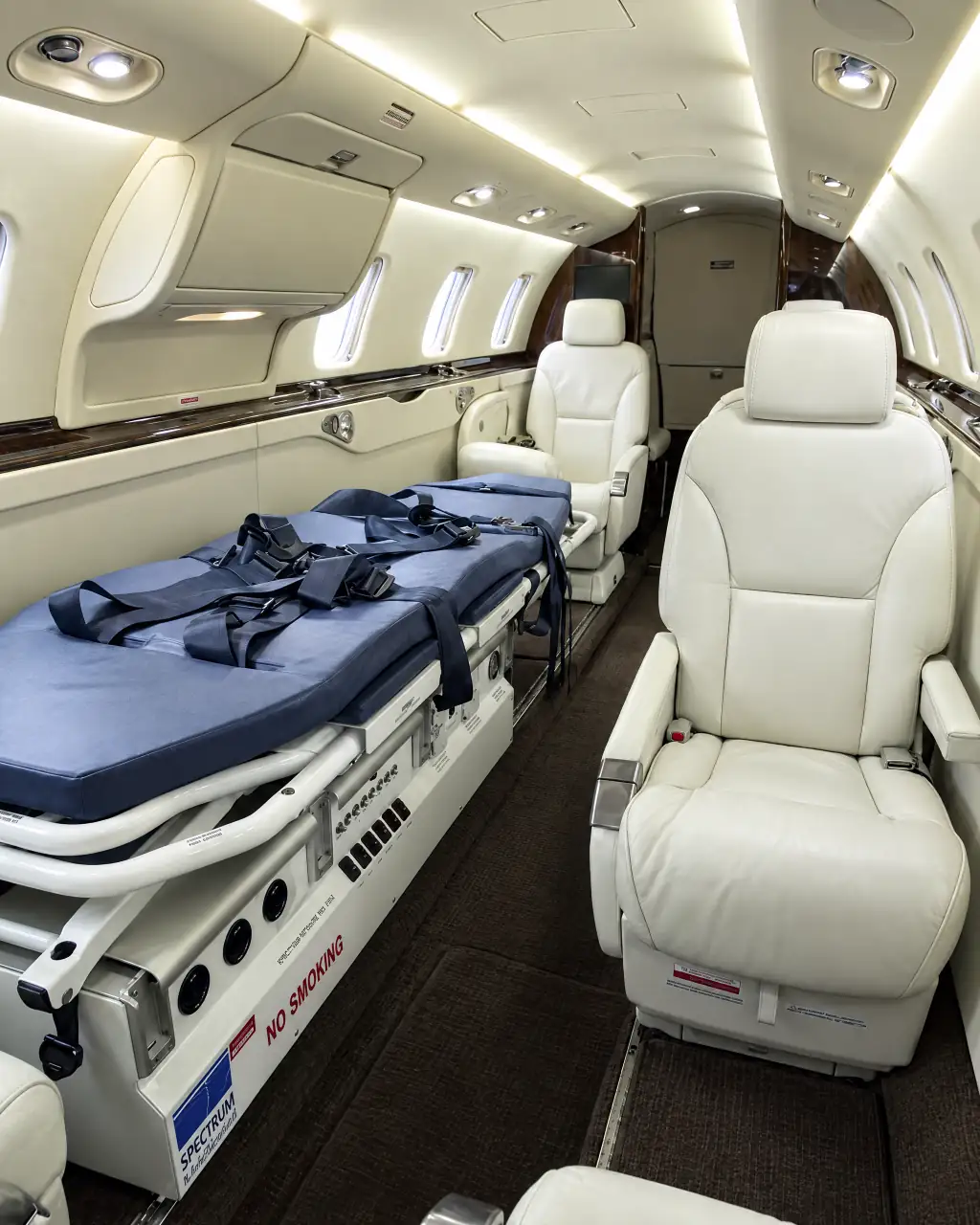
The cabin of a Learjet 60, set up with a stretcher.
Who arranges the ground ambulances?
We do, at both ends: from the treating hospital to the aircraft, and from the airport to the receiving hospital.
What is on board during the flight?
The medical crew is matched to the patient's condition, typically a flight physician and an ICU-trained nurse. A doctor is on call. Each jet has a monitor and defibrillator, transport ventilator, infusion pumps, suction and medical oxygen.
Is Red Dot accredited?
Yes. We are accredited by EURAMI, the European Aero-Medical Institute, after independent audits of our medical protocols, aircraft safety, crew qualifications, training and patient care.
The mission ends at the bedside, when our crew hands over to the receiving hospital.